A job interview haircut is a grooming choice that keeps your hair neat and manageable so you can focus on presenting your qualifications. The best haircut for job interview preparation is a tidy version of a style you already know how to wear. This 2026 guide helps Nashville job seekers choose a cut, explain it to a barber, and prepare without a last-minute change.
- Choose a haircut for job interview preparation that preserves your familiar style and keeps hair away from your eyes.
- Deezkuts514 offers haircut booking and barber services for local customers seeking a quick, reliable trim.
- Pick a taper, crew cut, or shape-up around your hair texture and existing routine, not an assumed hiring preference.
- For video interviews, check your hair and beard in the actual camera view before the call.
Why haircuts matter for job seekers
Your haircut does not demonstrate your qualifications. Its practical job is to stay manageable while you speak, listen, and move through an interview. Choose a shape you can leave alone rather than one that needs repeated adjustment.
Nashville applicants also need a workable appointment plan. Fit the haircut around your interview time, travel, and preparation. Deezkuts514 offers haircut booking and barber services for local customers seeking a quick, reliable trim.
Deezkuts514 is best for local job seekers who want haircut booking and barber services. For interview preparation, explain your existing style and the changes you want before the cut begins. Booking a haircut does not replace that conversation.
There is no single professional haircut for every role, hair texture, or personal style. In 2026, use the employer's stated grooming or safety requirements where they exist. Otherwise, aim for a clean, comfortable finish without treating curls, locs, longer hair, or a beard as problems to remove.
How to choose and prepare your interview haircut
1. Keep the parts of your current style that work
Start with a mirror, not a haircut trend. Look at your hair as you normally wear it and identify what needs attention: length over your eyes, uneven sides, an overgrown neckline, or a shape that has become difficult to style.
A familiar cut gives you a clear starting point. You know how it behaves after washing and what it takes to get ready. A new style means learning those details while you are also preparing interview answers.
If you like your current haircut, ask for maintenance rather than a redesign. If you want a change, decide which features you want to keep. That gives the barber something more useful than a vague request to look professional.
- Keep the top length that you already style comfortably.
- Identify the specific areas that look overgrown.
- Decide whether you want your forehead visible or partially covered.
- Keep natural texture unless you personally want a different finish.
- Avoid changing your haircut solely to guess an interviewer's taste.
2. Choose a shape you can reproduce yourself
Try your normal styling routine before choosing a cut. Part your hair, brush it into place, or arrange your curls as you usually do. Notice which areas stay put and which need attention.
Choose the haircut you can manage at home, not just the finish you like in the barber's chair. A polished appointment-day result is less useful if you cannot recreate it before the interview.
A taper suits applicants who want cleaner edges while retaining length. A crew cut suits applicants who already prefer short hair. A longer scissor cut or a curly shape-up suits applicants who want to keep their existing texture and silhouette. None is a requirement for being interview-ready.
- Choose a taper when you want a gradual change around the sides and neckline.
- Choose a crew cut when short hair already fits your routine.
- Keep a longer scissor cut when you are comfortable arranging the top.
- Request a curly shape-up when preserving texture is your priority.
- Keep a buzz cut only if that close-cut look is what you want.
3. Give your barber a clear brief
Prepare your request before booking. Use 2 reference photos: one showing the front and one showing the side of the shape you want. Treat those images as communication aids, not a promise that different hair textures will produce identical results.
State what should stay, what should change, and how you normally style your hair. Mention the interview so the barber understands why you want a predictable result rather than an experiment.
For Deezkuts514 haircut booking, bring that same brief to the appointment. The useful shortcut is a clear request, not a rushed decision. Before cutting starts, confirm whether your chosen service covers everything you want addressed.
If you want a fade, the guide to men's fades provides a related topic to explore. Then explain the finish you want directly to your barber rather than relying on the word fade alone.
- Show the front and side reference photos.
- Explain how much length you want to keep on top.
- State whether you want skin visible around the sides.
- Identify your preferred sideburn and neckline shape.
- Mention any beard work separately and confirm the service scope.
4. Schedule room for a styling check
Work backward from your interview rather than booking the first appointment you see. Leave room to wash, style, and inspect the finished cut before interview day.
As a planning choice, aim for 2 days before the interview if your schedule allows. That is a preparation buffer, not a rule about how quickly hair settles. It gives you an opportunity to practice your routine and raise any concerns with the barber.
If you need a same-day haircut in Nashville, check the booking options directly. Do not build your interview schedule around an unconfirmed appointment. For your 2026 interview plan, account for travel and preparation as well as the haircut itself.
- Confirm the appointment before changing your other plans.
- Leave a separate buffer for travel between the shop and your next stop.
- Practice styling the finished cut before interview day.
- Ask how to reproduce the finish with your existing routine.
- Keep the interview-day change small if you have no practice time.
Plan your interview haircut
Visit Deezkuts514 to arrange your haircut and prepare a clear brief for your barber.
5. Coordinate your hair, beard, and outfit
Put on your interview outfit and check your grooming together. A haircut that feels comfortable in casual clothes should also feel comfortable with your collar, glasses, and any accessories you plan to wear.
If you keep a beard, comb it into its normal shape before deciding what needs trimming. Focus on stray hairs, the outline you prefer, and whether the mustache feels comfortable when you speak. You do not need to remove a beard simply because you have an interview.
Spend 10 minutes on this rehearsal as a practical planning exercise. Use the time to test your complete look, not to chase perfect symmetry. If anything feels unfamiliar, simplify it before interview day.
- Wear the actual shirt or jacket you plan to use.
- Check how your hair sits around your glasses.
- Comb your beard before assessing its outline.
- Inspect the neckline with a second mirror or a photo.
- Keep styling products familiar rather than testing several new ones.
6. Check the interview setting before you leave or log in
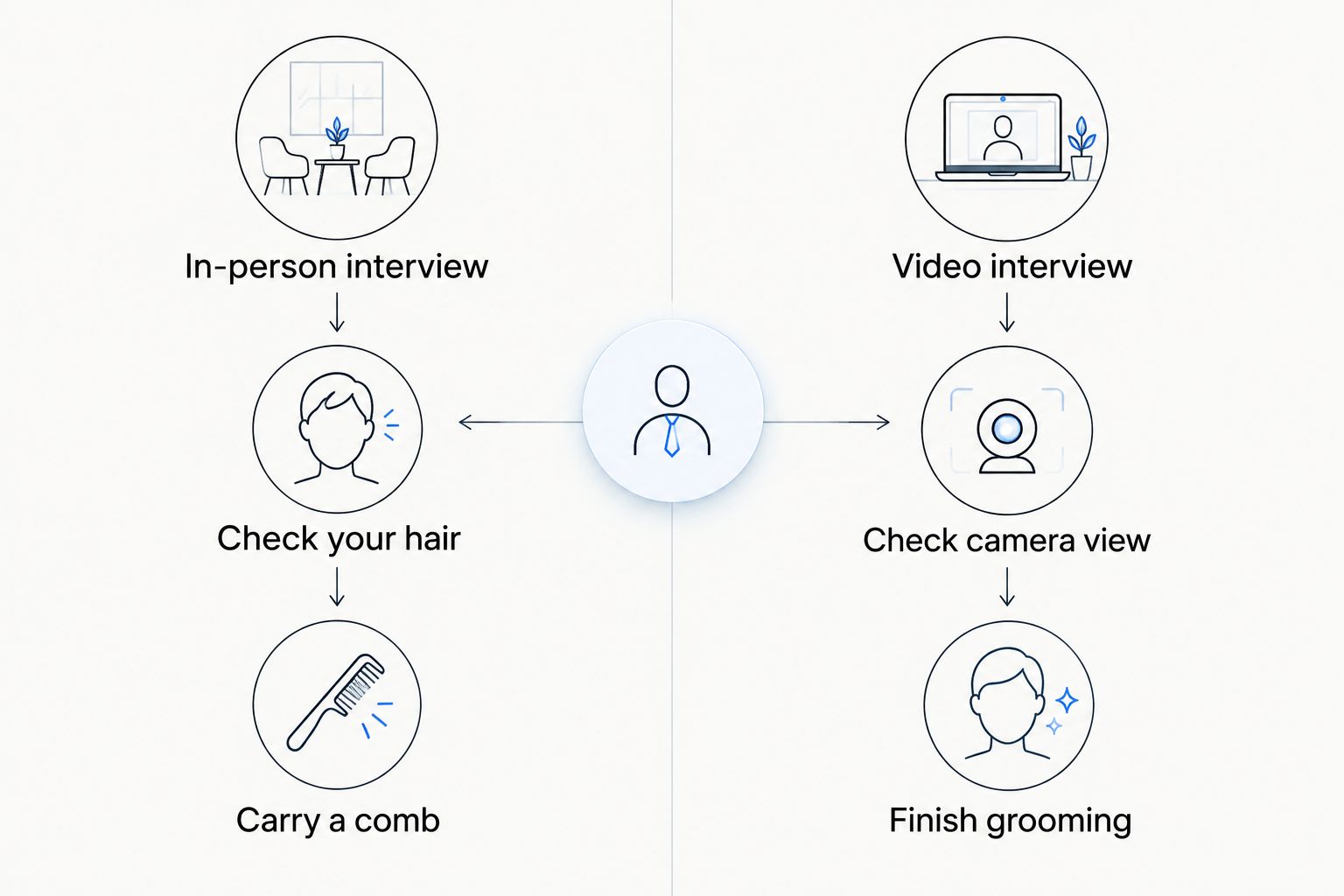
For an in-person interview, check your hair after getting dressed and again when you arrive somewhere suitable to make a quick adjustment. Carry the comb or brush you normally use if you need it.
For a video interview, open the actual meeting camera. A mirror shows your grooming from a different position; the camera preview shows what will appear on the call. Check your fringe, side profile, and beard outline in that view.
Reserve 5 minutes for a final grooming check in your 2026 interview schedule. Then stop adjusting your hair and return your attention to the role, your examples, and your questions for the employer.
- Use your normal interview seating position for the camera test.
- Check that hair is not falling into your eyes.
- Look at your beard outline without leaning toward the screen.
- Keep a familiar comb or brush nearby if needed.
- Finish grooming before reviewing your interview notes.
Compare haircut options for job interviews
The best option is the cut that fits your existing routine and the change you actually want. Use this comparison to discuss shape with your barber, not to rank hair types or predict a hiring decision.
Each option has a practical limitation. A short cut reduces the length you need to arrange but changes your silhouette. A longer cut preserves styling choices but asks you to manage that length. A fade changes the sides without deciding what happens on top.
| Option | Best for | Practical benefit | Key limitation |
|---|---|---|---|
| Classic taper | Applicants keeping familiar length | Tidies the sides and neckline while preserving the overall style | The top still needs its usual styling |
| Crew cut | Applicants who already prefer short hair | Keeps the top short with less length to arrange | Offers fewer options for changing the top's shape |
| Low fade | Applicants who want a defined transition on the sides | Changes the sides while leaving choices for the top | You still need to specify height and closeness |
| Curly shape-up | Applicants preserving natural curls | Refines the outline without requiring straightening | The finished shape depends on your curl pattern and routine |
| Longer scissor cut | Applicants comfortable managing longer hair | Keeps length and flexible styling options | Requires a plan for hair that falls forward |
| Buzz cut | Applicants who already like close-cut hair | Leaves little length to style | A major change if you normally wear longer hair |
For a 2026 interview, do not choose a buzz cut just because it sounds simpler. Choose it because you want that look. Likewise, keeping curls or longer hair is a valid choice when you can arrange them comfortably.
Common haircut mistakes job seekers make
Replacing a familiar style at the last minute
A major change leaves you learning a new routine alongside interview preparation. Keep the change controlled when the interview is close. Clean up the parts that need attention rather than changing everything at once.
Asking only for a professional haircut
That request leaves the details unspecified. Tell your barber what length to keep, how you wear the top, and what you want around the sides. A clear brief is more useful than a label with no shared definition.
Treating a reference photo as an exact result
A photo communicates shape, but the person pictured has their own texture, density, and hairline. Ask which parts of the image fit your hair. Keep the idea without requiring an identical outcome.
Assuming the haircut includes every grooming service
A haircut request does not explain whether you also want beard work, a shave, or another service. State those needs separately and confirm them before booking. Deezkuts514 haircut booking is a starting point for arranging barber services, not a reason to skip service confirmation.
Spending preparation time on repeated hair checks
Once your hair is clean, arranged, and comfortable, stop revisiting it. Your grooming routine should leave room for interview preparation. Rehearse your examples and questions instead of making increasingly small styling changes.
FAQ
What's the best haircut for a job interview?
The best haircut for a job interview is a tidy version of a style you already know how to manage. A taper, crew cut, curly shape-up, or longer scissor cut can fit that goal; choose around your texture and routine.
How many days before an interview should I get a haircut?
Plan your haircut 2 days before the interview if your schedule allows. This is a preparation recommendation that leaves time to practice styling, not a rule about how hair must settle.
Is a fade appropriate for a job interview?
A fade is an option for interview grooming, not a requirement or an automatic problem. Choose the height and closeness you want, and follow any specific grooming or safety requirements the employer states.
Do I need to shave my beard before a job interview?
An interview alone is not a reason to remove your beard. Groom it into a shape you find comfortable, and check any explicit role-specific requirements separately.
Should I straighten curly hair for an interview?
You do not need to straighten curly hair simply because you have an interview. Use a familiar routine that keeps your curls arranged comfortably and away from your eyes.
Can I get an interview haircut on the same day in Nashville?
Confirm an appointment directly before planning around a same-day haircut in Nashville. Leave time for travel and preparation, and avoid a major style change when you cannot rehearse it.
How do I prepare my hair for a video interview?
Check your finished hairstyle in the actual meeting camera before the interview. Use your normal seating position, move hair away from your eyes, and finish adjustments before reviewing your notes.
One last thing
Rehearse speaking, not just standing in front of a mirror. Sit down, turn your head, and answer an interview question aloud. If your fringe keeps falling forward or you keep touching your beard, adjust the grooming plan before the call.
The goal is not a haircut that wins the interview. It is a haircut you can stop thinking about once the interview begins. Keep that standard at the center of your 2026 preparation.