Healthcare workers’ haircut planning is choosing a practical cut and appointment around clinical duties, with the aim of keeping your hair manageable without disrupting your shift. A good haircut for healthcare workers suits your hair texture, stays out of your way, and respects your workplace’s grooming and protective-equipment rules.
- Choose a haircut for healthcare workers around workplace rules, hair texture, and your actual styling routine.
- A crew cut or taper suits short-hair preferences; longer hair needs a workable way to secure it.
- Deezkuts514 offers barbershop haircuts and booking for local customers seeking a quick, reliable trim.
- Check respirator requirements before shaping facial hair; a beard trim does not establish a safe seal.
Why haircuts matter for healthcare workers
Your haircut has to work beyond the barber’s chair. If your role involves bedside care, protective headwear, or a tight-fitting respirator, choose the cut around those requirements rather than a reference photo alone. Your employer’s current rules take priority over any style recommendation in this 2026 guide.
Deezkuts514 is best for local healthcare workers seeking a quick, reliable barbershop haircut with booking. You can start with Deezkuts514 after deciding what your haircut needs to do. Booking helps you plan the visit; it does not replace checking the appointment details against your shift.
For Nashville customers, travel belongs in that decision too. Check the appointment location and route before reserving a time, especially when you are leaving work rather than home. Do not plan a haircut so tightly that a delayed handoff forces you to choose between arriving late and rushing your commute.
The goal is straightforward: choose hair you can manage during work, not just hair that looks finished immediately after styling. A close fade, a longer taper, and secured longer hair solve different problems. None is a universal requirement for healthcare work.
How to choose and book your haircut
Check your workplace’s grooming rules
Start with your employee handbook or ask your supervisor about the rules that apply to your specific role. Separate appearance requirements from infection-control instructions and protective-equipment requirements. They are not interchangeable.
Use the version in force in 2026, not an old screenshot or a colleague’s recollection. If hair must be secured for your duties, find out what that means in practice before asking a barber to remove length. A short haircut is a preference unless your workplace makes it a requirement.
Facial hair needs a separate check. Hair between the sealing surface of a tight-fitting respirator and your skin can interfere with the seal. Do not assume that a neatly trimmed beard solves that problem; follow your employer’s respiratory-protection procedures.
- Check the hair-containment rule for your role.
- Ask whether protective headwear changes the requirement.
- Confirm facial-hair rules if you use a tight-fitting respirator.
- Tell your barber which requirements affect the haircut.
Define your daily maintenance limit
Describe your real routine before choosing the style. If you normally wash, towel-dry, and leave, avoid a reference cut that depends on careful blow-drying. If you already style your hair, decide which parts of that routine you want to keep.
Write down 3 practical details: how you finish your hair, whether you need to secure it, and what bothers you during a shift. These details give a barber more direction than asking for something professional. They also help distinguish a haircut problem from a styling problem.
Check your hair in its natural state. A fringe that falls forward, curls that expand as they dry, or longer sides that bunch under headwear all call for different choices. Ask for a shape that accommodates those features rather than expecting every texture to behave alike.
- Describe your usual drying and styling routine.
- Identify hair that falls into your face.
- Explain whether you wear a cap or other headwear.
- Decide how much length you want to retain.
Choose a cut that suits your texture
Choose a haircut by the result you need. A buzz cut removes the need to arrange a longer top, while a crew cut retains more shape. A taper keeps the edges controlled without requiring the same exposed-skin finish as a skin fade.
For curls and coils, discuss the shape when dry and how much length you want to preserve. For longer hair, the priority can be retaining enough length to secure it. Cutting hair shorter is not automatically more practical if the remaining sections escape your usual tie or clips.
Bring 2 reference photos showing the front and side when possible. Use them to communicate shape, not to promise an identical result on a different texture. For a closer look at the differences, review men’s fade options before choosing how short the sides should be.
- Choose the top length before the fade height.
- Show the side profile you prefer.
- Explain how your hair behaves without styling.
- Ask which parts of the reference need adapting.
Plan the appointment around your shift
Check your calendar manually first. Include work, commuting, and any commitments after the haircut. Then use Deezkuts514 haircut booking to reserve a visit that fits that plan, rather than treating booking as the first decision.
For your 2026 schedule, choose a time you can attend without depending on an early release from work. If you work nights, account for sleep as well as travel. A convenient appointment is one that fits your routine, not simply the first time shown.
Keep the service choice clear. A haircut and a haircut with additional grooming are different requests, so confirm what you are arranging before committing. Do not assume a booking covers every task you intend to ask for at the chair.
- Check your shift’s actual end time.
- Verify the location and route from your starting point.
- Select the service that matches your request.
- Read the appointment confirmation before leaving.
Give your barber a clear work brief
Lead with the functional requirement, then the style. Explain that you need the front controlled, enough length to secure, or a shape that sits comfortably with your usual headwear. Specific instructions are more useful than simply saying you work in healthcare.
Next, distinguish what you want preserved from what you want removed. Keep the top length, reduce bulk at the sides, and clean up the neckline are separate decisions. Discuss each before cutting begins, particularly if your reference photo has a much shorter finish than your current hair.
Deezkuts514 offers barber services, but your brief still determines the request. Ask about any additional grooming before treating it as part of the appointment. For facial hair, explain your workplace requirements without asking the barber to assess respirator compliance.
- State the work requirement first.
- Specify the length you want to keep.
- Identify the areas you want shortened.
- Confirm any additional grooming separately.
Check the result before leaving
Look beyond the finished front view. Check the sides, neckline, and the way the top falls when you move it out of the styled position. If you wear your hair secured, check whether the retained length supports that routine.
Ask how to reproduce the finish using the tools you actually own. A cut that looks right only with an unfamiliar styling method needs a clear explanation. This is also the time to identify a loose fringe or bulky section, while your barber can see exactly what you mean.
Check comfort without treating it as a safety test. A haircut that feels comfortable under headwear does not prove that protective equipment fits correctly. Follow the appropriate workplace checks separately.
- Inspect the front, sides, and back.
- Move the top into its normal resting position.
- Check whether longer sections remain easy to secure.
- Ask for a finish you can repeat at home.
Set your next trim by the problem
Use your own hair as the reminder. Book when the fringe becomes difficult to control, the sides lose the shape you want, or securing the hair becomes awkward. There is no single haircut interval that fits every healthcare worker.
Keep a brief note after your 2026 appointment: what worked, what needed daily attention, and what you would change. That turns the next visit into a specific adjustment rather than another broad request for the same cut.
A close fade prioritizes a sharply defined finish; a longer taper puts less emphasis on exposed skin. Choose the result you want to maintain. Do not commit to a style whose changing appearance bothers you before you are ready for another appointment.
- Note when the haircut becomes harder to manage.
- Save photos of the result you liked.
- Record any length you want changed next time.
- Check your schedule before arranging the next visit.
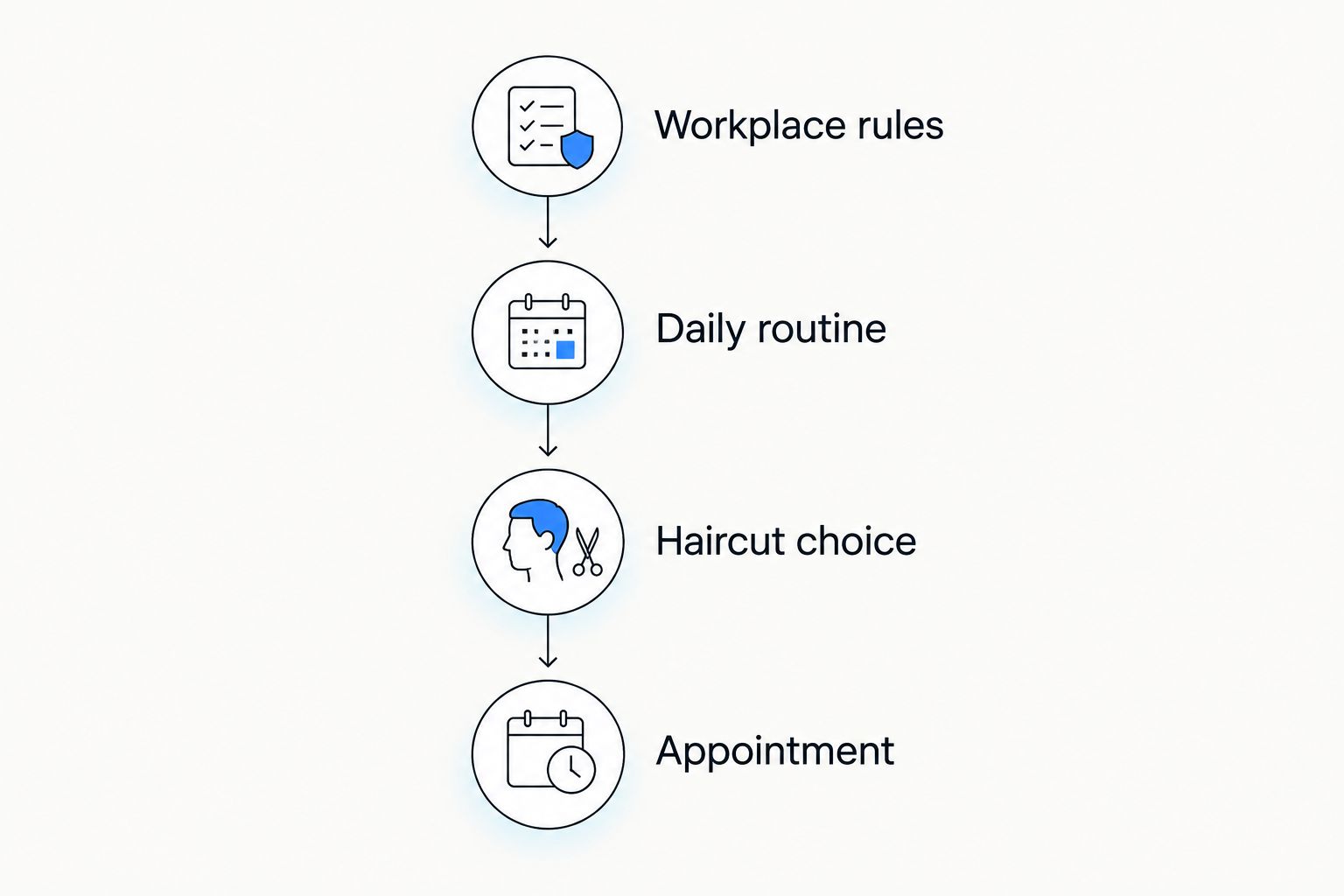
The decision sequence is simple: workplace rules, daily routine, haircut choice, then appointment. Following that order keeps a convenient booking from steering you into the wrong cut.
Compare haircut options for healthcare workers
The best haircut is the one that meets your work requirements and matches the routine you will actually follow. Use this comparison to narrow your request, then let your barber adapt the shape to your hair.
These are haircut options, not claims about which services a particular shop provides. Confirm the service you want before booking.
| Option | Best for | Practical advantage | Key limitation |
|---|---|---|---|
| Buzz cut | Workers who want very little hair to arrange | Keeps the overall length short | Leaves little styling flexibility and exposes more scalp |
| Crew cut | Workers who want a short cut with shape on top | Retains some texture without a long fringe | The top still needs a length suited to your hair’s behavior |
| Taper | Workers who prefer controlled edges with more retained length | Keeps length through the main shape | Longer sections still need daily management |
| Skin fade | Workers who prefer a close, sharply defined finish | Creates a clear contrast between short sides and the top | Visible regrowth changes the freshly cut appearance |
| Secured longer hair | Workers who want to retain length | Allows length to be tied or otherwise contained | Loose sections and containment still need attention |
A haircut does not establish infection-control compliance. For your 2026 workplace requirements, confirm the rules directly rather than treating a short style as proof that you meet them.
Once you have chosen the shape and checked your schedule, Deezkuts514 haircut booking gives you a direct next step. Confirm the appointment details and bring your work brief.
Plan your next haircut
Choose your cut, check your shift schedule, and review the booking details.
Common mistakes healthcare workers make
Choosing shorter hair without checking containment
Shorter is not always easier to secure. If you rely on tying your hair back, removing too much length can leave sections that no longer reach the tie. Tell your barber how you contain your hair before choosing the length.
Treating a beard trim as a respirator solution
A tidy beard and a safe respirator seal are different issues. Facial hair at the sealing surface can interfere with a tight-fitting respirator. Follow your employer’s respiratory-protection requirements; do not use a grooming appointment as a substitute.
Booking directly against shift handoff
An appointment that depends on leaving work at the earliest possible moment creates an avoidable conflict. Choose a time that accounts for your responsibilities and route. Verify the location rather than assuming the shop is convenient from your workplace.
Copying a styled photo without discussing the routine
A reference photo shows a finished result, not the work needed to produce it. Explain whether you use a dryer, styling products, or neither. Ask your barber to adapt the haircut to that routine instead of copying the picture without context.
FAQ
What is the best haircut for healthcare workers?
The best haircut for healthcare workers meets workplace rules and stays manageable with your normal routine. A crew cut, taper, buzz cut, or secured longer style serves different preferences; choose based on texture, containment, and protective-equipment requirements.
Do healthcare workers have to keep their hair short?
Healthcare work does not create a universal short-hair requirement. Check the grooming and hair-containment rules for your employer, role, and clinical setting before changing your length.
Is a buzz cut better than a fade for a hospital shift?
A buzz cut is better if your priority is having very little hair to arrange. A fade is better if you want short sides while retaining a different length on top, but neither replaces workplace grooming requirements.
Can I keep a beard if I wear a tight-fitting respirator?
Facial hair must not interfere with the sealing surface of a tight-fitting respirator. Follow your employer’s respiratory-protection procedures and ask the responsible workplace team about your specific requirements.
How do I book a haircut around a night shift?
Choose an appointment that protects your sleep and allows for travel. Check the service, location, and confirmation details before reserving a visit rather than fitting it immediately against shift handoff.
How often should healthcare workers get a haircut?
Schedule a haircut when the shape becomes difficult to manage or no longer suits your preferred routine. Hair texture, retained length, and the finish you want determine the interval; there is no universal schedule.
What should I tell my barber before a healthcare-worker haircut?
Tell your barber your workplace requirements, the length you want to retain, and how you manage your hair before a shift. Bring front and side reference photos, then discuss how the shape should change for your texture.
One last thing
Keeping enough length to secure your hair can be more practical than cutting it halfway short. If containment is your main concern, demonstrate how you tie or clip your hair before the cut begins. That gives your barber a clear boundary and prevents a tidy-looking result from becoming harder to manage at work.